
Index
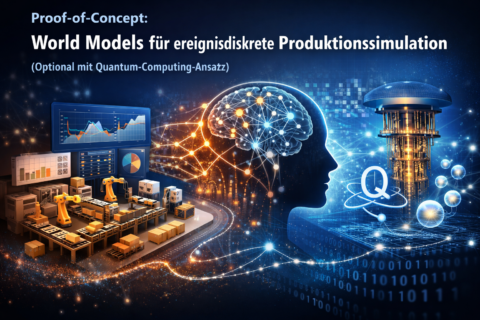
Proof-of-Concept: World Models für ereignisdiskrete Produktionssimulation (optional mit Quantum-Computing-Ansatz)
Titel:
Proof-of-Concept: World Models für ereignisdiskrete Produktionssimulation (optional mit Quantum-Computing-Ansatz)
Art der Arbeit:
Studienarbeit / Projektarbeit / Masterarbeit (nach Absprache)
Hintergrund und Motivation
Ereignisdiskrete Simulation (DES) ist ein etabliertes Werkzeug zur Planung und Optimierung von Produktionssystemen, stößt aber bei umfangreichen Szenariostudien und Optimierungsaufgaben an Grenzen hinsichtlich Rechenzeit und Automatisierung. World Models aus dem Bereich des modelbasierten Reinforcement Learning ermöglichen es, dynamische Systeme als lernbasierte Surrogate abzubilden und damit Entscheidungen und Policies in einem gelernten Modell statt in der vollständigen Simulation zu optimieren. Im Rahmen dieser Arbeit soll ein Proof-of-Concept erarbeitet werden, wie World Models für eine Produktions‑DES eingesetzt werden können, welche Potenziale und Anwendungsbereiche sich daraus ableiten lassen und inwiefern sich Ansätze zur quantenbasierten Parallelisierung perspektivisch nutzen lassen.
Ziel der Arbeit
Ziel der Arbeit ist die Konzeption und Umsetzung eines Proof-of-Concept, bei dem ein World Model als Surrogate für eine ereignisdiskrete Produktionssimulation dient und zur schnellen Bewertung von Steuerungs‑ bzw. Scheduling‑Strategien eingesetzt werden kann. Darüber hinaus sollen die Potenziale (z.B. Rechenzeiteinsparung, verbesserte Policy-Optimierung, neue Analyse‑Workflows) und konkrete Anwendungsbereiche in der Produktionsplanung systematisch herausgearbeitet und bewertet werden. Optional soll untersucht werden, welche Teilaspekte (z.B. Trajektoriensuche, Policy-Evaluation) prinzipiell durch Quantum-Computing‑Ansätze parallelisiert werden könnten und wie ein entsprechendes Forschungs-Setup aussehen würde.
Aufgabenstellung (Arbeitspakete)
1. Literaturrecherche
- Recherche zu World Models und modelbasiertem Reinforcement Learning (Dreamer, latent World Models) mit Fokus auf Produktions‑ und Simulationsanwendungen.
- Recherche zu bestehenden Ansätzen für Surrogate‑Modelle in der Simulation sowie ersten Studien zu Quantum Reinforcement Learning und quantenbasierter Parallelisierung von Trajektorien.
- Systematische Sichtung von Veröffentlichungen zu Potenzialen und Anwendungsfeldern von KI‑basierten Surrogates und World Models in Digitalen Zwillingen und Produktionssystemen.
2. Konzeption eines geeigneten Demonstrators
- Auswahl und Konzeption eines geeigneten DES‑Demonstrators für ein Produktionssystem. Im Best Case wird Siemens Plant Simulation verwendet; alternativ kommen SimPy (Python) oder AnyLogic in Frage.
- Festlegung einer kompakten Zustands‑ und Aktionsrepräsentation (State-Vector aus Queue-Längen, Maschinenzuständen, WIP etc.; Aktionen z.B. Dispatching-/Prioritätsregeln).
3. Implementierung eines World Models für DES
- Erstellung einer Datengrundlage durch Simulationstrajektorien aus dem gewählten DES‑Tool (bevorzugt Plant Simulation, alternativ SimPy oder AnyLogic).
- Implementierung oder Adaption eines World-Model-Ansatzes (z.B. DreamerV3‑ähnliche Architektur oder vereinfachtes latent dynamisches Modell) in Python.
- Training und Validierung des World Models als Surrogate: Vergleich von simulierten Trajektorien und relevanten KPIs im World Model gegenüber der ursprünglichen DES.
4. Proof-of-Concept: Einsatz des World Models und Potenzialanalyse
- Nutzung des World Models zur schnellen Bewertung von Steuerungs‑ oder Scheduling‑Strategien (z.B. durch Rollouts im gelernten Modell oder einfaches Planning).
- Quantitative und qualitative Analyse von Rechenzeit, Genauigkeit und Generalisierungsfähigkeit über mehrere Szenarien/Varianten des Produktionssystems.
- Herausarbeitung der Potenziale und Grenzen des Ansatzes für typische Anwendungsbereiche (z.B. Layout‑Variantenvergleich, Schicht- und Auftragsplanung, Engpass‑Management) und Ableitung von Handlungsempfehlungen.
5. Optionale Vertiefung: Quantum-Computing-Perspektive
- Sichtung relevanter Quantum-RL‑Literatur und Identifikation von Subproblemen (z.B. Trajektoriensuche oder Policy-Evaluation), die prinzipiell für eine quantenbasierte Parallelisierung geeignet sind.
- Konzeption eines skizzenhaften PoC‑Setups (z.B. auf Basis vorhandener Quantum‑Frameworks und kleiner Beispielumgebungen), das die Einbindung von Quantum-Computing in World-Model-basierte RL‑Ansätze demonstriert.
6. Dokumentation und Präsentation
- Systematische Dokumentation der Methodik, Ergebnisse, Potenziale und Grenzen des Ansatzes.
- Abschlusspräsentation der Arbeitsergebnisse am Lehrstuhl.
Voraussetzungen
- Laufendes Studium in Maschinenbau, Mechatronik, Wirtschaftsingenieurwesen, Informatik, Data Science oder einem vergleichbaren Studiengang.
- Grundkenntnisse in Python und Interesse an Maschinellem Lernen / Reinforcement Learning.
- Erste Erfahrungen mit Simulation (z.B. DES, agentenbasierte Modelle oder eigene Python‑Simulationen); Erfahrung mit Plant Simulation, SimPy oder AnyLogic ist von Vorteil.
- Selbstständige, strukturierte Arbeitsweise und Freude an forschungsnahen Fragestellungen.
Rahmenbedingungen
- Beginn: Nach Absprache, ab sofort möglich.
- Dauer: Entsprechend Prüfungsordnung (Studienarbeit/Projektarbeit/Masterarbeit).
- Die Arbeit ist in aktuelle Forschungsaktivitäten im Bereich Digitaler Zwilling, Simulation und KI am Lehrstuhl FAPS eingebunden.
Betreuung und Kontakt
Ansprechpartner:
Martin Barth, M.Eng.
Lehrstuhl für Fertigungsautomatisierung und Produktionssystematik (FAPS), FAU Erlangen-Nürnberg
E-Mail: martin.barth@faps.fau.de
Bitte senden Sie Ihre Bewerbung mit kurzem Motivationsschreiben, Lebenslauf und aktuellem Notenspiegel per E‑Mail an martin.barth@faps.fau.de
Multi-Physics Power System Optimization for LEO Constellations (Master/Bachelor)
This thesis focuses on designing and optimizing electrical power systems for LEO satellites and constellations, combining orbital mechanics, solar array design, battery sizing, and degradation effects. You will develop compact, physics‑based models that link orbit (altitude, inclination, eclipse duration) and environment (radiation, thermal cycling) to solar array and battery requirements. The goal is to create algorithms that are fast enough for constellation‑scale trade studies, but still grounded in realistic space environment assumptions.
Depending on your background (Energietechnik, Elektromobilität, Maschinenbau, Informatik), the work can emphasize modeling, algorithm development, or software integration into an existing simulation/optimization backend. You should enjoy working at the interface of physics, numerical methods, and code.
Mini demo challenge (attach repo link in your application):
Implement a small script or notebook that:
-
Computes orbital period and eclipse duration for circular LEO orbits over a range of altitudes (e.g. 400–800 km).
-
For a constant payload power and a chosen safety margin, computes the minimum required battery capacity for at least three altitudes and visualizes the result (table and/or simple plot).
-
In the README, briefly argue why you selected your specific language and libraries (e.g. NumPy vs. pure Python, MATLAB, Julia; Matplotlib vs. Plotly) and how this stack would scale to more complex multi‑physics problems.
The primary goal of the demo is to see how you choose tools and structure a tiny but clean engineering analysis.
Suggested reading:
-
DeGroh, K. et al., “Environmental Durability Issues for Solar Power Systems in Low Earth Orbit”, NASA TM‑106775.[ntrs.nasa]
-
Cunningham, K. et al., “Spacecraft Electrical Power Systems”, NASA Technical Report.[ntrs.nasa]
Application:
Interested candidates should submit their application to julius.pinsker@faps.fau.de including:
-
Current transcript of records (grades).
-
A concise CV (1 page).
-
A link to the mini demo repository described above.
I look forward to receiving your innovative applications.
Multi-Objective Optimization Framework for Satellite Constellation Design (Master/Bachelor)

This thesis aims to build a flexible multi‑objective optimization framework for satellite constellation design, capable of trading coverage, revisit time, number of satellites, and cost. You will implement and benchmark evolutionary algorithms (e.g. NSGA‑II/III) and/or other multi‑objective methods, and connect them to simplified or high‑fidelity constellation performance models. The work extends classic constellation optimization approaches with modern software engineering and, if desired, digital‑twin ideas similar to those used in recent ML‑enabled frameworks.
You will be free to choose your algorithmic and software stack (Python, Julia, C++, existing MOEA libraries, etc.), but you must justify these choices and design for extensibility (e.g. plug‑in objectives and constraints).
Mini demo challenge (attach repo link in your application):
Create a very small multi‑objective optimization example that:
-
Uses a 2‑objective toy problem (e.g. simple analytic “coverage” vs. “cost” or a standard test function such as ZDT1).
-
Generates ~50–100 candidate solutions and approximates a Pareto front (via your own GA or an optimization library).
-
Produces a scatter plot and a data file (CSV/JSON) of the non‑dominated solutions.
-
In the README, explain in a few sentences:
-
Why you chose a particular optimization library or implemented your own,
-
How you would extend this setup to real constellation design metrics and constraints.
-
The demo is intentionally small; the key signal is how you select, combine, and justify tools.
Suggested reading:
-
Chao, S.-L. et al., “Satellite constellation design optimization via multiple-objective evolutionary computation”, J. Guidance, Control, and Dynamics.[pure.psu]
-
Liu, J. et al., “Satellite Constellation Orbit Design Optimization with Combined Genetic Algorithm and Semianalytical Approach”, Advances in Astronomy.[onlinelibrary.wiley]
Application:
Interested candidates should submit their application to julius.pinsker@faps.fau.de including:
-
Current transcript of records (grades).
-
A concise CV (1 page).
-
A link to the mini demo repository described above.
I look forward to receiving your innovative applications.
Real-Time Digital Twin for Constellation Performance Prediction (Master)

This thesis focuses on building a machine‑learning‑enabled digital twin for satellite constellations: a fast surrogate model that predicts coverage, latency, and other key metrics in milliseconds, replacing or augmenting slower physics simulations. Inspired by the work of T.I. Zohdi and co‑authors on ML‑enabled digital twins for Planet‑X constellations, you will design data pipelines, train ML models, and benchmark their accuracy and speed against existing simulation outputs.
The emphasis is on combining a solid understanding of the underlying physics with modern ML tooling (e.g. scikit‑learn, PyTorch, JAX) and on creating an interface that can be integrated into optimization or interactive design tools.
Mini demo challenge (attach repo link in your application):
Write a small Python script or notebook that:
-
Defines a simple analytic “coverage score” as a function of (altitude, inclination, number of satellites).
-
Generates 100 random samples, trains any regression model (your choice), and compares predictions on 10 test samples.
-
In the README (3-5 sentences): explain why you chose that ML library and what you would do differently for real constellation data.
The goal is simply to see your ML library choice and how you think about the problem—not to build something complex.
The goal is to see how you think about ML model choice, data handling, and performance.
Suggested reading:
-
Zohdi, T.I. et al., “A machine-learning enabled digital-twin framework for the rapid design of satellite constellations for ‘Planet‑X’”.[msol.berkeley]
-
“Building Data-Driven Satellite Digital Twins”, Journal of Space Operations & Communicator.[iafastro]
Application:
Interested candidates should submit their application to julius.pinsker@faps.fau.de including:
-
Current transcript of records (grades).
-
A concise CV (1 page).
-
A link to the mini demo repository described above.
I look forward to receiving your innovative applications.
Solar Panel Degradation Modeling for LEO Satellites (Master/Bachelor/Project)

This thesis investigates how solar arrays degrade in the LEO environment due to radiation, atomic oxygen, and UV exposure, and how this affects end‑of‑life power budgets for small satellites and constellations. You will combine environment models with degradation data to build simplified yet credible lifetime models for different technologies and orbits.
The work can range from a more physics‑ and data‑oriented study (matching telemetry and literature data) to integration into an existing power sizing tool. Students from Energietechnik, Maschinenbau, or Informatik with interest in numerical modeling are welcome.
Mini demo challenge (attach repo link in your application):
Implement a small degradation model that:
-
Starts from an initial solar array power and applies simple yearly degradation factors combining a constant term and an altitude‑dependent radiation term.
-
Computes and plots relative power over 5–10 years for at least two LEO altitudes (e.g. 400 and 700 km).
-
In the README, briefly describe your assumptions and explain why you chose particular numerical and plotting libraries.
The demo should be small but clean, showing how you structure a quantitative degradation study.
Suggested reading:
-
Summers, G.P. et al., “Radiation-Induced Power Degradation for GaAs/Ge Solar Arrays”, SmallSat Conference.[digitalcommons.usu]
-
“Evaluation and prediction of the degradation of space Si solar cells under complex space environment”.[zgwlc.xml-journal]
Application:
Interested candidates should submit their application to julius.pinsker@faps.fau.de including:
-
Current transcript of records (grades).
-
A concise CV (1 page).
-
A link to the mini demo repository described above.
I look forward to receiving your innovative applications.
Battery Management System Requirements for Space Applications (Master/Bachelor)

This thesis derives and structures requirements for Battery Management Systems (BMS) in LEO missions, considering eclipse cycling, temperature swings, radiation, and mission lifetime. You will translate orbital and load profiles into BMS requirements (sensing accuracy, SOC/SOH estimation, balancing strategy, redundancy) and compare terrestrial and space‑specific BMS architectures.
The work combines systems engineering with some quantitative modeling (C‑rates, thermal limits, degradation) and is suitable for students in Elektromobilität, Energietechnik, or Wirtschaftsingenieurwesen with an interest in space systems.
Mini demo challenge (attach repo link in your application):
Create a small tool that:
-
Takes orbital period, eclipse duration, average payload power, and nominal battery voltage as inputs.
-
Computes required usable capacity, average C‑rate during eclipse, and a recommended SOC operating window for two different mission cases (e.g. short‑lived high‑power vs. long‑lived low‑power).
-
Outputs a short markdown or JSON “BMS requirement snippet” for each case.
-
In the README, explain your choice of language, data structures, and how you would extend this to a more detailed requirement generator.
The main goal is to see how you formalize requirements and select tools to support that.
Suggested reading:
-
NASA Technology Transfer, “Battery Management System” (MSC‑TOPS‑40).[technology.nasa]
-
“Architectures for Lithium Ion Based Power Subsystems”, The Aerospace Corporation.[aerospace]
Application:
Interested candidates should submit their application to julius.pinsker@faps.fau.de including:
-
Current transcript of records (grades).
-
A concise CV (1 page).
-
A link to the mini demo repository described above.
I look forward to receiving your innovative applications.
Thruster Selection Database and Decision Tool (Bachelor/Project/Master)

This thesis develops a structured database and decision tool for thruster selection in small satellite missions, with a focus on electric and chemical propulsion options for LEO constellations. You will gather data on representative thrusters, structure it in a queryable form, and design selection logic that recommends suitable options based on mission delta‑v, power, mass, and operational constraints.
The work is well suited for students in Elektromobilität, Maschinenbau, or Informatik who enjoy combining propulsion basics with data modeling and software tools.
Mini demo challenge (attach repo link in your application):
Build a minimal thruster selection prototype that:
-
Stores 5–10 example thrusters (type, thrust, Isp, power, mass, TRL) in a machine‑readable format (JSON/CSV or a tiny database).
-
Provides a simple CLI or script that, given required delta‑v and available power, filters infeasible thrusters and ranks the feasible ones by a simple score (e.g. mass or propellant efficiency).
-
In the README, explain:
-
Why you chose your data format and parsing/CLI framework,
-
How you would scale this to a much larger catalog and richer selection criteria.
-
The demo is intentionally small; what matters is your tool and data modeling choices.
Suggested reading:
-
“Electric propulsion methods for small satellites: a review”, University of Stuttgart.
-
Hofer, R. et al., “Electric Propulsion for Small Satellites: A Case Study”, IEPC.
Application:
Interested candidates should submit their application to julius.pinsker@faps.fau.de including:
-
Current transcript of records (grades).
-
A concise CV (1 page).
-
A link to the mini demo repository described above.
I look forward to receiving your innovative applications.
Techno-Economic Optimization of Constellation Deployment Strategies (Master)
This thesis couples technical and economic models to compare deployment strategies for LEO constellations: dedicated launches, rideshare missions, orbital transfer services, or hybrids. You will build cost and schedule models and combine them with simplified technical constraints (e.g. required onboard propulsion for different drop‑off orbits). The aim is to identify strategies that minimize total cost and risk while meeting deployment timelines.
The work is ideal for Wirtschaftsingenieurwesen, Informatik, or related students interested in both space systems and quantitative decision models.
Mini demo challenge (attach repo link in your application):
Implement a small deployment cost comparison that:
-
Defines at least two deployment options (e.g. “all dedicated launches” vs. “all rideshare + extra propulsion”), each with simple cost and schedule parameters.
-
Computes total cost for deploying a fixed number of satellites under each option and, optionally, uses a simple optimization or search to find the cheapest mix under a deadline constraint.
-
In the README, explain your modeling choices and why you selected a particular optimization or simulation tool (e.g. OR‑Tools, PuLP, SciPy, or something else).
The objective is to see how you formalize a techno‑economic trade and select appropriate tools.
Suggested reading:
-
Escamilla Estrada, B. I. et al., “A Concurrent Methodology for Optimizing Constellation Deployment and Launcher Selection”, EUCASS Conference Paper.[eucass]
-
Straub, A. N., “Deployment Strategies for Reconfigurable Satellite Constellations”, MIT / AIAA ASCEND.[dspace.mit]
Application:
Interested candidates should submit their application to julius.pinsker@faps.fau.de including:
-
Current transcript of records (grades).
-
A concise CV (1 page).
-
A link to the mini demo repository described above.
I look forward to receiving your innovative applications.
Supply Chain Optimization for CubeSat Component Procurement (Master/Bachelor)

This thesis addresses supply chain optimization for CubeSat and small satellite components, considering lead times, minimum order quantities, cost, and obsolescence risk. You will formulate procurement models that match constellation build schedules with supplier capabilities and explore strategies to reduce risk and cost through better sourcing, buffering, and standardization.
The topic is especially suitable for Wirtschaftsingenieurwesen and Informatik students who enjoy combining optimization, data handling, and real‑world industrial constraints.
Mini demo challenge (attach repo link in your application):
Develop a tiny procurement planner that:
-
Defines a toy bill of materials with a few subsystems and 2–3 suppliers per component (different costs, lead times, and MOQs).
-
Computes a feasible procurement plan that meets a specified assembly start date while minimizing total cost (simple heuristic or small optimization model).
-
In the README, describe:
-
Your data modeling choices (formats, libraries),
-
Why you chose a particular solver or heuristic approach,
-
How you would incorporate uncertainty in lead times or supplier failure.
-
The demo is designed to see how you structure a constrained planning problem and select appropriate libraries and solvers.
Suggested reading:
-
NASA NEPP, “CubeSat Parts Lists and Supply Chain”, ETW 2015 presentation.
-
NanoAvionics, “Navigating CubeSat and Small Satellite Procurement”.
Application:
Interested candidates should submit their application to julius.pinsker@faps.fau.de including:
-
Current transcript of records (grades).
-
A concise CV (1 page).
-
A link to the mini demo repository described above.
I look forward to receiving your innovative applications.
Entwicklung einer Konfigurationslösung für die Simulation und Validierung regelkonformer gleichstrombasierter Produktionssysteme

Motivation
Gleichstromnetze gewinnen in modernen und nachhaltigen Produktionsanlagen zunehmend an Bedeutung. Sie ermöglichen eine effizientere Integration erneuerbarer Energien, Speicher und leistungsstarker Verbraucher. Mit der steigenden Komplexität solcher Netze wächst jedoch auch die Herausforderung, sie regelkonform, konsistent und nachvollziehbar zu konfigurieren.
Simulationstools spielen hierbei eine zentrale Rolle: Sie erlauben es, Gleichstromnetze virtuell aufzubauen, unterschiedliche Konfigurationsvarianten zu untersuchen und deren Verhalten unter realistischen Betriebsbedingungen zu analysieren. Voraussetzung für belastbare Simulationsergebnisse ist jedoch eine strukturierte und regelbasierte Modellierung der Netze.
Im Rahmen dieser studentischen Arbeit soll daher eine Wissensbasis für das institutseigene Simulationstool DCign entwickelt werden. Diese Wissensbasis unterstützt die Konfiguration und Validierung regelkonformer Gleichstromnetze und bildet die Grundlage für eine enge Kopplung zwischen Konfigurationslogik und Simulation.
Aufgabenstellung
Ziel der Arbeit ist die Entwicklung einer Wissensbasis zur regelkonformen Konfiguration von Gleichstromnetzen sowie deren Integration in simulationsbasierte Modelle. Die Arbeit gliedert sich in folgende Schwerpunkte:
Analyse bestehender Ansätze
-
Untersuchung vorhandener Konfigurationsmechanismen, Algorithmen und Tools
-
Bewertung ihrer Eignung für den gegebenen Anwedungsfall
Entwicklung einer Wissensbasis für die Konfiguration
-
Aufbau einer initialen Sammlung von Regeln, Abhängigkeiten und Strukturen zur Modellierung
-
Fokus auf Konfigurierbarkeit, Konsistenzprüfung und Regelkonformität
-
Berücksichtigung typischer Komponenten nachhaltiger Produktionsanlagen (Erzeuger, Verbraucher, Speicher)
Strategie zur Konfigurationslösung
-
Entwurf einer Methodik zur Erstellung, Verwaltung und Anwendung von Konfigurationsregeln
-
Ausrichtung auf Modularität, Anpassbarkeit und Erweiterbarkeit für zukünftige Anforderungen
-
Vorbereitung einer engen Kopplung zwischen Konfiguration und Simulation
Kopplung mit der Simulation
-
Integration der Wissensbasis in das Simulationstool DCign
-
Ableitung simulationsfähiger Modelle aus der Konfiguration
-
Definition von Ansätzen zur Validierung der Modelle durch Simulation (z. B. Plausibilitätsprüfungen, Szenarioanalysen)
Zielsetzung
Ziel der Arbeit ist die Erstellung einer erweiterbaren und adaptiven Wissensbasis, mit der Gleichstromnetze regelkonform modelliert und simuliert werden können. Damit soll eine Grundlage geschaffen werden, um in DCign automatisch die Validität von Modellen prüfen und sicherstellen zu können.
Voraussetzungen und Informationen
- Profil:
- Studium der Elektrotechnik, Energietechnik, Mechatronik, Informatik, Maschinenbau oder eines verwandten Fachbereichs.
- Sehr gutes Deutsch und Englisch in Wort und Schrift
- Selbstständige Arbeitsweise erforderlich
- Interesse an innovativen Energieversorgungstechnologien, Simulationen oder Automatisierung
- Kenntnisse in der Programmierung (insbesondere Python) und Interesse an Schnittstellentechnologien von Vorteil.
- Selbstständige und strukturierte Arbeitsweise, Teamfähigkeit sowie gute Kommunikationsfähigkeiten.
Was wir bieten:
- Einblicke in die spannende Forschungsarbeit im Bereich Simulation, Automatisierung und Gleichstromnetzwerke und hybride Energienetze.
- Die Möglichkeit, an zukunftsweisenden Projekten in einem engagierten Team mitzuwirken.
- Eigenverantwortliches Arbeiten an realen Projekten mit modernster Technologie.
- Möglichkeit zur persönlichen und fachlichen Weiterentwicklung.
- Kooperation mit führenden und regionalen Industrieunternehmen zur Gleichstromtechnologie.
- Bei Projekt-/Masterarbeit: Möglichkeit eines Research Masters und anschließender Promotion gegeben
Das DC-Team am Lehrstuhl besteht aus mehreren Wissenschaftlern und Studierenden, die ihre Arbeiten im Team erledigen und sich gegenseitig unterstützen, weshalb eine Bereitschaft für regen Austausch untereinander gewünscht ist. Auch in dieser Arbeit ist die Vergabe der Arbeitspakete konkurrenzlos in mehrere Teilaufgaben untergliederbar.
Beginn: Ab sofort möglich. Die Position ist als Bachelor- Projekt- oder Masterarbeit verfügbar.
Kontakt:
Interessierte Studierende senden bitte ihre Bewerbungsunterlagen (kurzes Motivationsschreiben, Notenzettel und Lebenslauf) an Martin.Barth@faps.fau.deHinweis: Aufgrund der hohen Anzahl an Anfragen werden Bewerbungen, die durch ChatGPT erstellt wurden, sowie Anfragen ohne alle relevanten Dokumente, nicht beantwortet.